

In a monastery in 14th-century Europe, a scribe could spend his entire working life copying a single Bible by hand. One man. One book. Forty years of candlelight and cramped fingers, and at the end of it, one object.
Then Gutenberg built a press.
Suddenly the same words a scribe gave his life to could be produced in an afternoon. The skill didn’t change. The knowledge didn’t change. What changed was the leverage — the ratio between the effort you put in once and the output you get back forever.
Most doctors are still scribes.
We sell expertise the way the monk sold manuscripts: one patient, one shift, one hour at a time. Brilliant, hard-won knowledge — delivered linearly, traded once, and gone. And for the whole of medical history, that was the only option available to us.
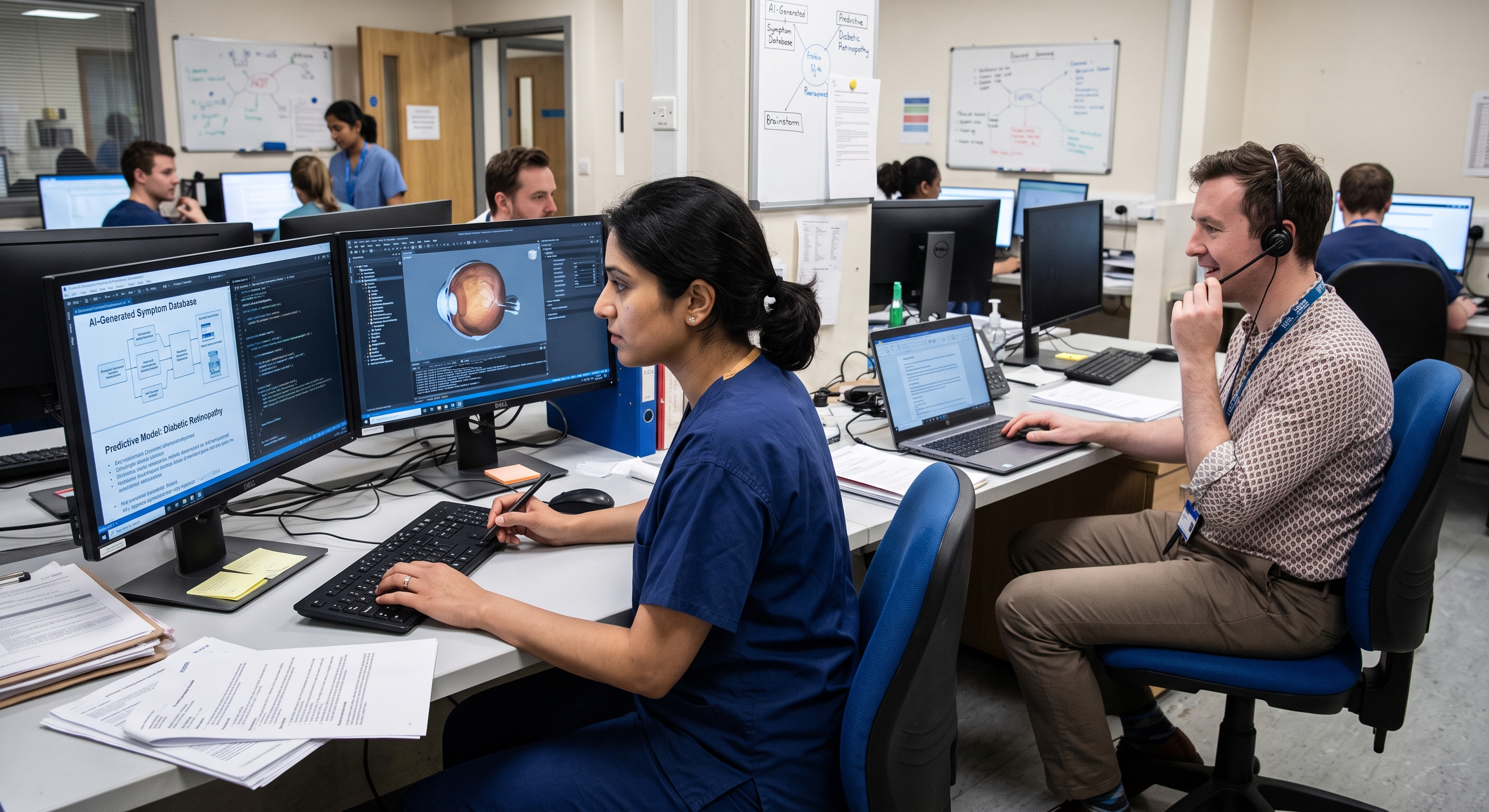
It isn’t anymore. For the first time, a single doctor has access to a printing press for their own expertise. I’ve spent the last year building one. Here is what it actually looks like.
The Scribe’s Trap
Clinical medicine is the purest form of linear income there is.
You show up. You trade an hour of your life. You get paid for that hour. Stop showing up, and the income stops with it. There is no version of NHS work where you do something once and get paid for it for the next ten years.
This is the trap underneath doctor burnout. Not the workload itself — the structure of the income. Your earnings are permanently chained to your physical presence. The only levers you’re offered are: work more hours, or wait two decades for the pension.
Locums feel like an escape, but they’re the same trap with a higher hourly rate. You’re still a scribe. You’ve just negotiated a better price per manuscript.
To build anything that isn’t linear, you have always needed one of two things: capital, or a team. Money to buy assets that earn without you. Or people to multiply your output beyond your own two hands.
Most doctors have neither the spare capital nor the spare time to assemble either. So they stay scribes, and they call it the only realistic option.
That was a fair conclusion in 2019. It is wrong now.
The Expertise Engine
Here’s the framework I’ve been building my whole non-clinical life around. I call it the Expertise Engine: capture your knowledge once, then use AI to multiply it into many assets that keep working after you’ve put your laptop down.
The principle is simple. The expertise already exists in your head — you paid for it with a decade of training. The bottleneck was never knowledge. It was the labour of converting that knowledge into something that scales: writing it up, formatting it, turning it into teaching, packaging it, distributing it.
That conversion labour is exactly what AI now does well.
Think of it as three stages:
→ Capture once. A clinical insight, a teaching point, a hard-won lesson — recorded or written down a single time.
→ Multiply with AI. That one input becomes a newsletter, a set of teaching slides, exam questions, a script, social posts — in minutes, not weekends.
→ Distribute and compound. The assets sit online and keep earning attention, subscribers, and income while you’re on a night shift.
The scribe copied one manuscript per lifetime. The Engine lets one doctor produce a library.
What I Actually Built This Month
Let me be specific, because vague “AI will change everything” talk is worthless.
I run two education channels — Emergency Medicine Update, for doctors revising for the FRCEM exam, and Building Out, which is what you’re reading. I also have a consultant-level portfolio to assemble for my CESR application, which is itself a small mountain of admin.
A year ago, producing one week of content across both channels was a weekend’s work. Researching the topic, writing the long piece, cutting it into smaller posts, formatting everything, scheduling it. Six, seven hours minimum, every single week. That’s a weekend with my kids I wasn’t getting back.
Now the same week of content takes me closer to two hours of actual decision-making — and the rest runs through systems I’ve built with AI. I bring the clinical judgement, the angle, the voice, the final yes-or-no. AI does the conversion labour that used to eat the weekend.
The CESR portfolio is the part that genuinely surprised me. Reflective write-ups, mapping evidence against capabilities, the relentless formatting — work that consultants routinely describe as taking hundreds of hours – has become a structured pipeline rather than a second unpaid job.
None of this replaced my expertise. You cannot prompt your way to knowing how to manage a crashing patient or what a registrar actually needs the night before an exam. The judgement is still mine. AI just removed the hours between having the insight and shipping it.
That is the whole game: I’m no longer paid only for the hours I’m physically present. I built assets that work while I sleep. Quietly, on my days off, I stopped being only a scribe.
The Leverage Gap
Here’s why this matters far beyond content.
There is a widening gap between doctors who understand leverage and doctors who don’t. I call it the Leverage Gap, and it’s going to define the next decade of medical careers more than any pay deal.
On one side: the doctor who responds to financial pressure the only way they know how — pick up another locum shift. Sell another hour. Linear, capped, exhausting.
On the other: the doctor who spends a fraction of that same time building something that earns more than once. An education product. A piece of content that brings in subscribers for years. A system that turns one skill into many income streams.
The second doctor isn’t working harder. They’re working with leverage. And AI has just dropped the cost of entry to almost nothing — no team to hire, no agency to pay, no capital required up front.
The maths is stark. An extra weekend locum might net you a few hundred pounds, once. The same weekend spent building an asset earns nothing on day one — and potentially compounds for years. Most doctors take the few hundred pounds, because it’s certain and immediate. That certainty is exactly what keeps them scribes.
Financial freedom for doctors was always going to come from one of two places: assets that earn without you, or income that isn’t chained to your hours. AI is the first tool in history that lets an ordinary, time-poor doctor build both, in the margins of an NHS career, without permission from anyone.
Where the Engine Breaks
I’m not a hype merchant, so let me be honest about the limits.
AI will not give you expertise you don’t have. It amplifies what’s already there — and it amplifies emptiness just as efficiently. A doctor with deep clinical knowledge and a clear voice gets enormous leverage. A doctor with nothing to say gets a faster way to say nothing.
It also won’t do the thinking for you. The bottleneck moves. It used to be the labour of production; now it’s the quality of your judgement, your angle, your taste. The doctors who win with this aren’t the best prompters. They’re the ones with something real to multiply.
And it requires you to start before it pays. Same as every asset ever built.
Your Move This Week
You don’t need to build a business by Friday. You need to stop being only a scribe. Start here:
- Pick one thing you already know cold. A clinical topic, a system you’ve figured out, a lesson you’d teach a junior. Expertise you already own — no new learning required.
- Capture it once, properly. Write it down or talk it through for twenty minutes. This is the raw material the Engine runs on. Don’t polish it — just get it out of your head.
- Use AI to make three things from that one input. A short article. A set of teaching points. A social post. Watch one capture become three assets. Feel the leverage for yourself.
- Ship one of them publicly. Imperfectly. The asset that earns is the one that exists, not the one that’s perfect in a drafts folder.
- Do it again next week. Leverage compounds. One asset is a fluke. Fifty is an engine.
The scribes who survived the printing press weren’t the ones who copied faster. They were the ones who learned to run the press. The same choice is sitting in front of every doctor right now — and almost nobody is making it on purpose.
Be the one who does.
For more topics on building a life of time and financial freedom, sign up for our weekly newsletter at www.building-out.com
This post is for educational purposes only and does not constitute financial advice. Always do your own research and, if needed, ask for advice from a qualified financial adviser regulated by the FCA.































































Leave a Reply