

AI in medicine doesn’t need cheerleaders or blanket refusers. It needs doctors who understand it well enough to judge it.
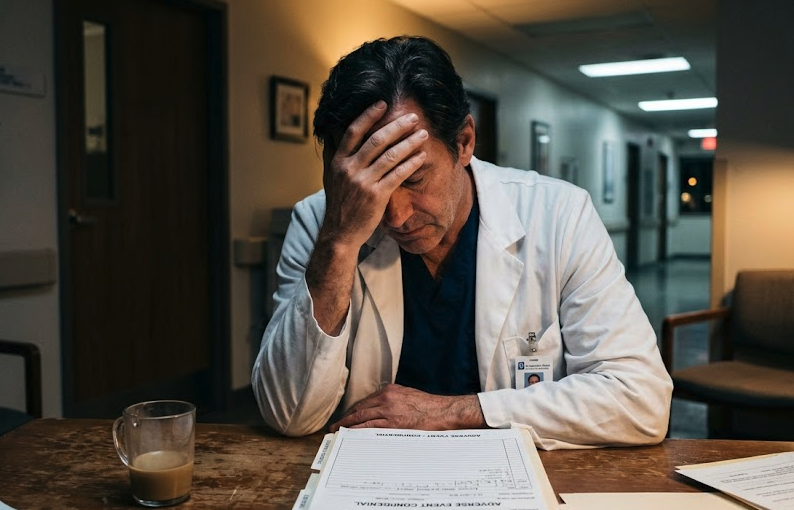
Another doctor said it to me during a conversation about AI.
“We lose our humanity.”
I understand the instinct. Nobody went into medicine to be replaced by a chatbot. However, I think our humanity is a reason to understand AI. It isn’t a reason to stop asking questions about it.
I hear other objections too. AI is bad for the environment. AI is cheating. Or it produces rubbish. Each points towards a concern worth taking seriously. So the useful next question is: which task, which risk, and compared with what?
My case is simple. Doctors don’t need to embrace AI uncritically. We do need to understand enough about it to judge where it helps, where it harms and when it shouldn’t be used.

Two concerns about AI in medicine I take seriously
The first is the environment. Data centres use electricity and water. However, a per-prompt estimate is only one part of the picture. For instance, it doesn’t capture every impact of building and training models. And costs vary between systems and tasks.
The second is information governance. Don’t put patient-identifiable or confidential information into an unapproved tool. Instead, follow your organisation’s policy. Use tools approved for the specific task, and check the output. Even so, approval alone isn’t a licence to use any data for any purpose. I’ve written more on the patient-data trap.
In short, these concerns deserve more than a slogan. They deserve evidence, clear boundaries and an honest discussion about trade-offs.
What “we use our humanity” misses
Think about the parts of a shift that need you. Explaining a scan. Listening to a worried relative. Making a judgement when the picture doesn’t fit neatly.
Now think about the paperwork around them: discharge summaries, referral letters, portfolio entries, rota emails and teaching preparation. Admittedly, some of that work requires careful human judgement too. But if an appropriate tool can help with part of it, we may get time back. Time for patients, or for life outside work.
Of course, that isn’t guaranteed with AI in medicine. Poorly implemented technology can add work or create new risks. Still, the point is to examine the task rather than dismiss the possibility.
Where the evidence on AI in medicine is interesting
At the keyboard. I use AI to help with workplace-based assessments, teaching sessions, educational newsletters and email drafts. Crucially, I don’t put patient data into those tools. Afterwards, I check and take responsibility for the final work.
In education. A registrar can ask a tool to turn a guideline into practice questions. Used well, it can be a useful revision aid. But the questions and explanations can be wrong. So check them against the original guidance.
In screening. In Sweden’s MASAI trial, the 2025 analysis reported 338 screen-detected cancers in the AI-supported group and 262 in the standard-reading group. It also reported about 44% fewer screen readings. Importantly, that is an increase in detection, not proof on its own of reduced mortality. The UK’s EDITH study is investigating AI-supported breast screening with NHS readers.
At the research frontier. The 2024 Nobel Prize in Chemistry recognised David Baker for computational protein design. It also recognised Demis Hassabis and John Jumper for protein structure prediction using AlphaFold. An AI-discovered drug candidate for idiopathic pulmonary fibrosis, rentosertib, has reported results from an early phase 2a trial. Even so, it remains a candidate, not a proven treatment.
None of this makes the risks disappear. However, it does make a blanket “AI is rubbish” too simple.
The checking is the job
Every use of AI in medicine shares one weakness. It can be fluent, confident and wrong in the same sentence. A better prompt can help, but it cannot remove that risk.
My rough rule is 5% / 90% / 5%. I start with the idea and brief. Next, I use AI to help build a draft. Then I check the final work. Those numbers describe my workflow. In other words, they are not a measured division of effort. In fact, sometimes checking takes much longer. For anything that matters, it should take as long as it needs.
What to do this week
- Sharpen one objection. Name the task, the specific risk and what you would compare it with. If you can’t yet, use that uncertainty to guide what you look up next.
- Look at the environmental evidence. Google estimated that the median Gemini Apps text prompt in May 2025 used 0.24 watt-hours and consumed 0.26 ml of water, about five drops. That’s a company estimate for one service at one point in time. It isn’t a figure for every AI prompt. Also, training and other lifecycle impacts are separate. Consider both individual use and the total demand.
- Time one non-clinical task. Try a rota email or teaching plan in the usual way. Then use an organisation-approved tool for a comparable task. Again, don’t enter patient or confidential data. Check the output and local policy. Compare the time honestly.
- Catch it out. Ask a tool a clinical question you know well, without patient details. Check the answer line by line against current NICE or RCEM guidance. A single test won’t reveal every failure mode, so keep checking each output.
- Improve the conversation. Next time a colleague says AI in medicine is “cheating” or “rubbish”, ask: “Which task, and compared with what?” Then listen, because their concern may be one you haven’t considered.
The bottom line on AI in medicine
Patients need our humanity and our judgement. Understanding AI’s limitations is part of deciding whether, and where, it can support either.
Most doctors I speak to don’t want to quit. They want one day back. I share what I’m learning about getting there.






















































Leave a Reply